 Tweet
Tweet
Originally posted by Gregs_gsxr
View Post
-
It would Probly have a bad vibration if the ujoint was badsigpic1997 firehawk # 115 6 speed. Its just a little ole LT1 -
IDK what a u-joint is..."IROCZ86"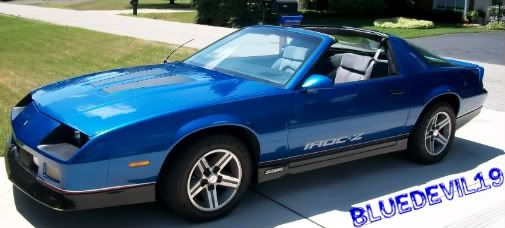
Comment
-
a u joint allows a drive shaft, or half shaft, to pivot with out binding, on an f-body there are 2 u-joints one on the out put shaft of the trans and one on the rear end input shaft'91 Camaro Modded, LSx, House of Kolor Intense White, lowered, GS chrome 18" wheels, 14" Brembo CTS-V on all 4 corners, LS rear end, FP suspension components
" When in doubt...throttle out ! "
ENVYsion Entertainment GroupComment
-
Eek....I'd stick to brake/carb cleaner or propane - just spray around the intake and vacuum lines.Originally posted by Fbomb View Post
Was the TPS set properly? .42-.45 @ idle and 4.5+volts at WOT?2000 Formula
fixed slow junkComment
-
Had no vibrations when I owned it, I drove it from Commerce to Sterling Heights at least once a week. No vibrations what so everOriginally posted by 97firehawk View Post'91 Camaro Modded, LSx, House of Kolor Intense White, lowered, GS chrome 18" wheels, 14" Brembo CTS-V on all 4 corners, LS rear end, FP suspension components
" When in doubt...throttle out ! "
ENVYsion Entertainment GroupComment
-
My trans guy gave me the number for an engine guy im guna talk to and see"IROCZ86"Comment
-
did you get the trans mount squared away ? did you do it or what did you pay to have it done ?'91 Camaro Modded, LSx, House of Kolor Intense White, lowered, GS chrome 18" wheels, 14" Brembo CTS-V on all 4 corners, LS rear end, FP suspension components
" When in doubt...throttle out ! "
ENVYsion Entertainment GroupComment
-
http://www.thirdgen.org/tpimod2
IAC and TPS Adjustment
Tom Keliher Mar 31 2006 - 4:07pm Idle Air Control
Tools needed:
- Torx bit # T-20
- Paper Clip
- Small Punch
Take the paper clip and open it up and form it into a big "U" shape. Insert the clip ends into the ALDL in the 'A' and 'B' pins.
Turn on the ignition, but don't start the engine. Wait 30 seconds. Now, go remove the connector from the IAC.
Start engine. You are now going to adjust "minimum air". There is a Torx screw on the side of the throttle body. This is what needs to be turned to adjust minimum air, or more commonly known as "idle speed". It comes from the factory with a protective metal cap over it. If the cap is still there, use a small punch to knock it out. Set the idle speed to 450 rpm, rotating the Torx screw clockwise to raise rpm, and counter-clockwise to lower rpm. Once the idle rpm is set, turn off the engine.
Re-connect the connector onto the IAC. Start engine. Idle speed is now once again governed by the ECM, but your idle should be smooth and steady, approximately 600 rpm in Drive (for unmodified cars).
If you set an SES light by having the IAC disconnected, then after shutting down the engine disconnect the negative battery terminal. Wait 5 minutes. This will clear the ECM of all trouble codes. Re-connect the battery and drive the car for 20 minutes to allow the ECM to relearn your driving style.
Throttle Position Switch (TPS)
Tools needed:
- Digital Volt-Ohm-Meter (VOM)
- Jumper Wires (make your own)
- Auto Xray Scanner (if available) will eliminate the need for VOM and jumper wires.
Turn on ignition, but don't start the engine.
With a scanner: plug in the scanner and read the TPS voltage. It should be 0.54Volts +/- 0.075Volts
With VOM and jumper wires: disconnect the connector from the TPS. Using your jumper wires, make a connection allowing some room for the VOM terminals to contact the jumper leads and read the TPS voltage.
If out of spec, loosen the two screws holding the TPS to the throttle body, and slightly rotate the TPS up or down, reading the voltage until it comes into specification. Tighten screws. Using the throttle lever, rotate the throttle to WOT (wide open throttle). The TPS voltage should be over 4.0 volts. Close the throttle again, and then slowly open it to WOT, observing the voltage reading. It should increase progressively and in a linear fashion. If it sticks or jumps or falls off at all while doing this check, that could mean a bad TPS switch and could be a cause of stumbling and driveability problems.
After setting the correct voltage, turn off ignition switch. Remove jumpers/scanner and reconnect the TPS connector as required.Comment

Comment