Announcement

Collapse
No announcement yet.

Building a motor, should i use this stuff?

Collapse
X
Collapse
Who has read this thread:
 
  • Filter
  • Time
  • Show
Clear All
new posts

  • Building a motor, should i use this stuff?

    Im building a motor right now, id like to know how much HP/TQ i can expect from this setup. If you have any ideas for improvements, let me know please.

    60's Corvette Block bored .040 over.
    Speed Pro .040 pistons.
    3.48 stroke
    5.7 rods
    Vortec heads- P/N 10233906 with stock 1.94/1.50 with 64cc chambers. Stock springs, recommend me a set for cam below.

    Considering these rocker arms- http://www.summitracing.com/parts/SCC-SCP1036BL/

    Cam specs.

    DURATION AS ADVERTISED INTAKE: 308° EXHAUST: 318°
    DURATION @ .050 INTAKE: 234° EXHAUST: 244°
    LIFT @ CAM (Lobe) INTAKE: 0.325" EXHAUST: 0.34"
    LIFT @ VALVE INTAKE: 0.488" EXHAUST: 0.51"
    LOBE SEPERATION: 112° INTAKE CENTERLINE: 107° IDLE VACUUM @ 1000 RPM: 11"

    Running this intake with a Holley 770 cfm carb from a 68 Camaro- http://www.summitracing.com/parts/PFS-52030/

    Also will be running a Mallory distributor, dont remember the P/N off the top of my head.

    Will probably be dropping this setup in our S10 come spring time. May get bigger valves for the heads. Will be running a th350 for now, possibly with a 3200 stall.

    Im just trying to figure out how much flywheel horsepower i can expect.
    96 BBB Impala SS-Fixed, Broke, Fixed again
    95 DCM Caprice Wagon-STRKDIT
    93 Caprice Classic- Whore

  • #2
    That's not that radical of a setup really.

    Are the pistons flat tops?
    Is there a reason why your boring the block to near maximum other than displacement?
    Why are you using a vette block? Is it a 2 bolt main or a 4 bolt main block?
    Make sure you consult with the cam manufacturer and your cam card on what load of springs you need.
    You can't guess - your valvetrain must be matched up to the engine, and the usage of the vehicle. (Weight, tire size, gearing, etc)

    My Recommendation:
    Save the Vette block for later in life. Find a good early 70s 4 bolt main block for strength and commonality.
    Or... find a 70-71 Chevy 400 block for cubes and convert it to a roller cam.
    Another option would be to find a late model 4 bolt main block to match the vortech heads - that way you get the 1 pc rear main oil seal, and you don't have to dink around so much with the 2 pc seal.

    If you stay to current, Im going to guess around 350 flywheel HP.
    The 400 would get you easily over 400hp if done correctly.
    Last edited by TrickyTransAm; November 27th, 2011, 11:40 AM.

    Comment


    • #3
      325-350 hp

      Comment


      • #4
        Originally posted by Curt_irocz View Post
        325-350 hp
        Thats what I was thinking as well.
        What is the casting number on the engine block?
        Know that all corvettes used 283's until 1962 and 327s until 1968, and in 1969 they changed to 350s. If it were me I would lean towards using a 350

        Comment


        • #5
          With that set-up I think you would be doing good if you got 350hp at the crank.
          sigpic
          Turbo Charged LS1/T56

          Comment


          • #6
            I was thinking same thing 325-350 at crank. Rear wheel HP would be about 300 - 310.
            sigpic
            1998 Trans Am Convertible A4 - WS6 hood, WS6 air lid, WS6 rims, drilled/slotted rotors.

            Comment


            • #7
              Great Package for cheap power!

              Put together correctly this little simple set up runs HARD. Back when this build up in CHP started I pieced one together myself with excellent results, to the tune of pushing my 3460lb Buick Apollo with a 3.42 rear and 2500 stall to a best of 12.70@109.

              You are over the lift that the vortecs will allow without machining down the valve guides though. With the larger cam, and single plane I would make sure you have plenty of converter behind it. Definitely going to have to upgrade those springs! The other thing is it is highly advisable to have them machined for screw in studs, at the very least, and while you are there if you plan on those rr's you will need to be set up for guideplates.

              Read the following THOROUGHLY to the end if you want to get an idea where they started and how they ended up at 402 at the crank on a very similar setup. I went with the larger 224/230 cam they thought would be too much for the street and it was awesome, the cam you are looking at is a bit more, and I would love to give that one a shot in mine. Copy the article to a T and it will motivate that S10 like you wouldn't believe!

              Oh, and don't believe all the BS about the 906 castings you read online either. Unless they came from a HD truck application they are just as good as the 062's.

              http://www.corvettefaq.com/c3/goodwr...20part%201.htm
              Last edited by TOOSLO86; December 1st, 2011, 01:39 PM.

              Comment


              • #8
                at the end of the first or second paragraph this article says he has the truck shit heads

                http://www.chevyhiperformance.com/ho...458/index.html

                Comment


                • #9
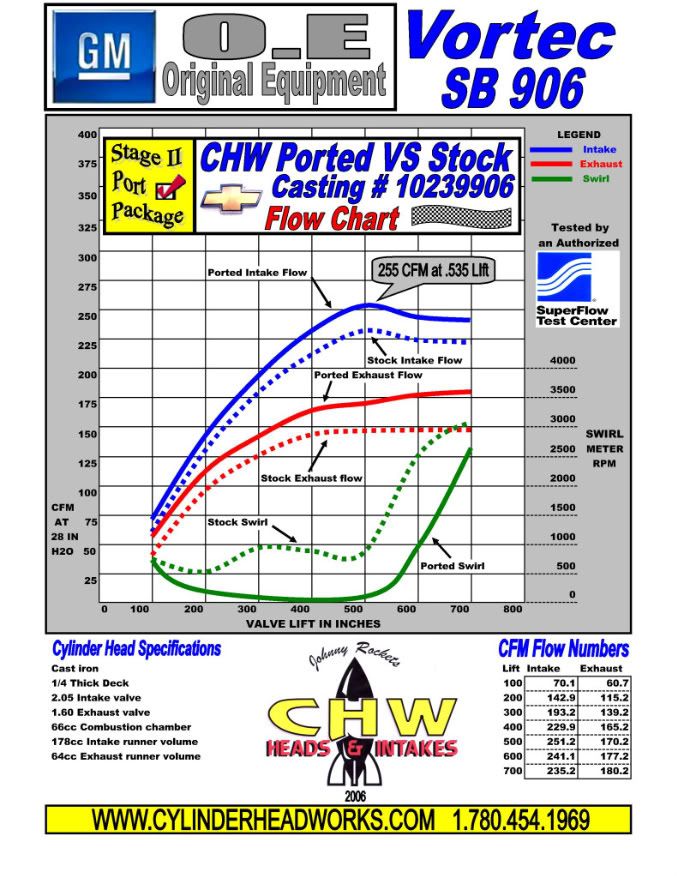
                  don't exspect to buy any vortec head and have it produce good numbers. even though it would still be a upgrade. i hope you dont have this casting number 10239906 those commonly don't flow air with-out machine work to the seats. Casting numbers isn't something to nessarly go by in the vortec world, the part number for the head will get you in the right dirrection. although better results have been had going with the 12558062 casting becouse there where 2 part numbers under it. 1 had 64cc cumbustion chamber and 170cc intake runners, while the other part number also bearing the same casting had a 68cc cumbustion chamber and alot smaller intake runners. your best bet would to either buy the gm fast burn vortec 12367713 that had 2.0in/1.55. or seek the vortec head that came in the L-31 option truck in 1998 part number 12558060 with the casting number being 12558062. understand something both the 906 and the 062 head are the same just one has different valve seats that greatly hinders the flow. And you will see diiferant people say differant things about the 2 heads as stock. i'v seem them on the flow bench and know what there differance is. then modified them to 2.02/1.6 valves and they ran hard. with alittle porting they can be some really nice heads. hope that helps. good luck.
                  Last edited by masterfab; December 4th, 2011, 02:20 PM.

                  Comment


                  • #10
                    Originally posted by 86Camaro View Post
                    at the end of the first or second paragraph this article says he has the truck shit heads

                    http://www.chevyhiperformance.com/ho...458/index.html
                    And yet it goes on, still after all these years. Following excerpt was taken right from Sallee Chevrolet;

                    Please Note: The casting number myth debunked:
                    The myth is that there is a difference in the head performance produced by these two castings.
                    This myth was started by some Magazines that didn't do their homework before publishing their articles.
                    This is the truth the whole truth and nothing but the truth. So sayith the Grand Wizard GM and his Apprentice Wizard Chevrolet.
                    10239906 casting has one large single hump.
                    12558062 casting has 3 small humps.
                    If either of these two castings have not been altered by GM and the part number changed from 12558060 or altered by someone else (previous owner, etc.), the heads produced by either casting will be identical except for the external cosmetic difference. Both castings are used to make the 12558060 Vortec heads which are the true unaltered Vortec heads.
                    Heads from both castings come out of their cast IDENTICAL except for the minor cosmetic external differences!!!!!!!!

                    And another quote;

                    Two Vortec castings were used from 1996-99 on GM CK trucks ('00 in vans) and SUV's utilizing the Vortec 5700 350 engine. The #906 and #062. The #906 casting head was available in two versions. One has an Inconel exhaust seat with a single angle grind, and the other has the conventional 3-angle grind on the exhausts as per the #062. The #906 with Inconel seat does not intrude into the exhaust port. It was used primarily on the HD and 1-ton truck applications where sustained towing of heavy loads & weight up inclines could cause eventual damage to a standard induction-hardened exhaust seat from excessive heat.
                    The only difference between the #062 and #906 Vortec head is in the exhaust seat of the HD/1-ton truck #906 version, as described above. The #062 has a 3-angle grind on a standard induction-hardened seat, as does the non-HD #906 head. The 062 does flow slightly better on the exhaust side at low lifts but the advantage over a 906 is very slight. They both utilize back-cut exhaust valves. They both have 3-angle grind seats on the intakes with back-cut intake valves. Both heads make the same power in stock form.
                    Vortec heads were used exclusively in trucks and SUV's. No passenger cars were equipped with these heads.
                    Stock out-of-the-box Vortec heads have approx. 480HP potential naturally-aspirated. Fully race-ported flowing 275 cfm @ 28" water with 2.055/1.60 valves, potential is approx. 580 HP. There are reports of some shops getting close to 300 cfm out of these heads in fully-ported form.
                    Retainer to guide clearance is the primary Achille's Heel of the Vortec. For valve lifts above .460" they need to be checked for R-G clearance. This varies from head to head. Some find they can get .480" and slightly more valve lift fine. Others will find .460" about the limit. Always check R-G with any performance cam above .460".

                    I personally have the 906's also, the ones with the standard exhaust valve seats, they are excellent heads for the $. If your 906's came off of a HD then yea, above posts should be heeded. If not, throw em on and run it, you won't find a better head for the $. I think 109mph verifies the capability of a stock cast 906 head, but none-the less, skeptics will still debate it.

                    Comment


                    • #11
                      Originally posted by TOOSLO86 View Post
                      And yet it goes on, still after all these years. Following excerpt was taken right from Sallee Chevrolet;

                      Please Note: The casting number myth debunked:
                      The myth is that there is a difference in the head performance produced by these two castings.
                      This myth was started by some Magazines that didn't do their homework before publishing their articles.
                      This is the truth the whole truth and nothing but the truth. So sayith the Grand Wizard GM and his Apprentice Wizard Chevrolet.
                      10239906 casting has one large single hump.
                      12558062 casting has 3 small humps.
                      If either of these two castings have not been altered by GM and the part number changed from 12558060 or altered by someone else (previous owner, etc.), the heads produced by either casting will be identical except for the external cosmetic difference. Both castings are used to make the 12558060 Vortec heads which are the true unaltered Vortec heads.
                      Heads from both castings come out of their cast IDENTICAL except for the minor cosmetic external differences!!!!!!!!

                      And another quote;

                      Two Vortec castings were used from 1996-99 on GM CK trucks ('00 in vans) and SUV's utilizing the Vortec 5700 350 engine. The #906 and #062. The #906 casting head was available in two versions. One has an Inconel exhaust seat with a single angle grind, and the other has the conventional 3-angle grind on the exhausts as per the #062. The #906 with Inconel seat does not intrude into the exhaust port. It was used primarily on the HD and 1-ton truck applications where sustained towing of heavy loads & weight up inclines could cause eventual damage to a standard induction-hardened exhaust seat from excessive heat.
                      The only difference between the #062 and #906 Vortec head is in the exhaust seat of the HD/1-ton truck #906 version, as described above. The #062 has a 3-angle grind on a standard induction-hardened seat, as does the non-HD #906 head. The 062 does flow slightly better on the exhaust side at low lifts but the advantage over a 906 is very slight. They both utilize back-cut exhaust valves. They both have 3-angle grind seats on the intakes with back-cut intake valves. Both heads make the same power in stock form.
                      Vortec heads were used exclusively in trucks and SUV's. No passenger cars were equipped with these heads.
                      Stock out-of-the-box Vortec heads have approx. 480HP potential naturally-aspirated. Fully race-ported flowing 275 cfm @ 28" water with 2.055/1.60 valves, potential is approx. 580 HP. There are reports of some shops getting close to 300 cfm out of these heads in fully-ported form.
                      Retainer to guide clearance is the primary Achille's Heel of the Vortec. For valve lifts above .460" they need to be checked for R-G clearance. This varies from head to head. Some find they can get .480" and slightly more valve lift fine. Others will find .460" about the limit. Always check R-G with any performance cam above .460".

                      I personally have the 906's also, the ones with the standard exhaust valve seats, they are excellent heads for the $. If your 906's came off of a HD then yea, above posts should be heeded. If not, throw em on and run it, you won't find a better head for the $. I think 109mph verifies the capability of a stock cast 906 head, but none-the less, skeptics will still debate it.
                      i agree with you to the part of 480hp stock head out of the box. iv seen these heads on the flow bench and have worked with them alot. more than i care to. they are a great budget upgrade. but 480hp is high. considering the 1.94/1.50 valves and the small cc runners. iv never seen 300cfm out of these either your talking huge numbers in the sbc world. considering dart pro 1's flow just alittle over that. here some stock flow numbers. not trying to argue but the are facts to these heads and you coverd alot of them but this one i know from years of engine building.


                      and heres flow on a set of AFR 190cc 2.02/1.60 vortec heads

                      Heres some info from some porting on a 906 casting that i googled

                      Comment


                      • #12
                        I guess I should have put a disclaimer that the quoted text was not of my opinion, just showing others. I was just trying to show that you can't believe everything you read about the 906's being junk. I surely can't vouch for 480hp let alone the flow that was claimed on them. I would have to agree that those are some extremely worked over heads. Heck if I recall when CHP did a 406 vortec headed build they only squeezed 420hp due to the fact the as cast heads couldn't keep up. The amazing thing was that they made like 525lb/ft.

                        On a more actual, (as in I've seen it many times) note there is a gentleman that runs out at Stanton in a 3800lb Vette sporting a 383 around 11.5 compression with a cam in the 240@.050 duration and topped with a set of vortecs and on the motor this thing runs 11.6-7's. They are plenty capable budget pieces as you stated.

                        Regardless, I'm still in the boat for the OP not going wrong by using these in his build.

                        BTW Sniper, are you on the north side of 21 just east of Slingerland?

                        Comment


                        • #13
                          Originally posted by TOOSLO86 View Post
                          I guess I should have put a disclaimer that the quoted text was not of my opinion, just showing others. I was just trying to show that you can't believe everything you read about the 906's being junk. I surely can't vouch for 480hp let alone the flow that was claimed on them. I would have to agree that those are some extremely worked over heads. Heck if I recall when CHP did a 406 vortec headed build they only squeezed 420hp due to the fact the as cast heads couldn't keep up. The amazing thing was that they made like 525lb/ft.

                          On a more actual, (as in I've seen it many times) note there is a gentleman that runs out at Stanton in a 3800lb Vette sporting a 383 around 11.5 compression with a cam in the 240@.050 duration and topped with a set of vortecs and on the motor this thing runs 11.6-7's. They are plenty capable budget pieces as you stated.

                          Regardless, I'm still in the boat for the OP not going wrong by using these in his build.

                          BTW Sniper, are you on the north side of 21 just east of Slingerland?
                          i understand it was research you posted. i just wanted to make sure everyone knew that those where very unlikely numbers. its always nerv racking replying to a post like that becouse i dont want anyone to think im directly remarking in a rude mannor.

                          im south of 21 and east of slingerland. to be more exact im about 2 miles north of I-69 off m13.

                          Comment

                          Working...
                          X